


Evaluating Tcal thus requires to determine both Temi and
 .
Assuming the receiver temperature is known, the noise
power received on the sky Temi is given by
.
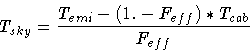
Assuming the receiver temperature is known, the noise
power received on the sky Temi is given by
 |
(7) |
 |
(8) |
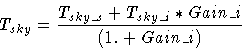
In case of a double side-band receiver and single side-band signal,
Tsky is a sum of the contribution of the two receiver bands
weighted by the sideband gain ratio (gain in the image band
divided by gain in the signal band).
 |
(9) |
To determine the opacity ,
the trick is to model the atmospheric emission to derive
the transmission. There is some hope that it can work (at least in
reasonably good conditions) because the transmission is dominated
by a few constituants, among which only the water vapor
varies significantly with time. Hence, if the atmosphere can be modelled by
a small number of layers, it is possible to derive the transmission from the
emission. The atmospheric model used (ATM, J. Cernicharo) is derived
from a ``Standard atmosphere'' and the knowledge of
the Atmospheric pressure Pamb and outside Temperature Tamb(and the altitude of the site). Together with the season in the year,
these parameters give a good approximation of the
physical temperature of the absorbing layers.
By a minimization routine, with the amount of precipitable water vapor
in millimeters as variable, the best model fitting the measured Tskyis found. Then, for each band (signal and image),
the total zenith opacities are computed by summing the opacities
due to Oxygen and Water, with a small empirical correction factor
for other minor constituents.
The zenith opacities are used together with the elevation (number of
air masses) to compute Tcal, the SSB scaling factor
 |
(10) |
 is the zenith opacity in the signal sideband.