


Phases being angles are naturally defined in radians (or degrees). For the amplitude two units might be of interest : flux densities (in Jansky) or brightness temperatures (in Kelvin). In principle, after atmospheric amplitude calibration have been applied, the amplitude naturally comes out in brightness temperature scale, which can be converted just knowing the primary beam size into flux density. However, unavoidable effects such as short term atmospheric phase fluctuations add extra degradations to the amplitude scale.
Accordingly, it is often necessary to refer the amplitude scale to a primary (or secondary) calibrator of known flux density. To summarize, amplitude may be displayed in 3 different modes and 2 units, with the following factor :
Unit  Mode Mode | ABSOLUTE | RELATIVE | SCALED |
| KELVIN | 1 |  | 1/S |
| JANSKY |  | 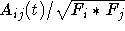 | 1/S |
 are the efficiencies of antenna in Jy/K,
  is the amplitude calibration factor (in K/Jy) and S the source flux
in Jy.
is the amplitude calibration factor (in K/Jy) and S the source flux
in Jy.
Calibrating the amplitude usually implies determining both the
and functions.