


This last step of the program performs a posteriori control of the robustness of the reconstruction process.
When prompted by the program:
Q-WIPE DO YOU WANT TO CONDUCT ERROR ANALYSIS ? [y,n] yif the answer is yes, the program will compute the condition number
 ,
the eigenvalues
,
the eigenvalues  and eigenmodes
of the reconstruction operator.
and eigenmodes
of the reconstruction operator.
I-WIPE   This may take some time. Please wait...

Krylov 2: mu = 3.995562e-01, mu' = 5.566639e-01, kappa = 1.180341e+00
Krylov 3: mu = 3.017594e-01, mu' = 8.600131e-01, kappa = 1.688193e+00
Krylov 4: mu = 2.584568e-01, mu' = 1.026722e+00, kappa = 1.993115e+00
Krylov 5: mu = 1.981331e-01, mu' = 1.194734e+00, kappa = 2.455597e+00
Krylov 6: mu = 1.479192e-01, mu' = 1.257864e+00, kappa = 2.916115e+00
...
Krylov 33: mu = 7.118590e-02, mu' = 1.295405e+00, kappa = 4.265852e+00
Krylov 34: mu = 7.118544e-02, mu' = 1.295405e+00, kappa = 4.265866e+00

lambda[0] = 0.071185    theta[0] = 88.789797
lambda[1] = 0.073799    theta[1] = 88.306748
lambda[2] = 0.121578    theta[2] = 82.808893
lambda[3] = 0.135521    theta[3] = 85.752680
...
lambda[32] = 1.287797   theta[32] = 89.913183
lambda[33] = 1.295405   theta[33] = 89.933163
 and
and  are respectively the smallest and largest eigenvalues
of the reconstruction operator.
The condition number
of the same operator is defined as
are respectively the smallest and largest eigenvalues
of the reconstruction operator.
The condition number
of the same operator is defined as

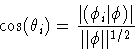
 between the solution,
  ,
and the
eigenmode i,
,
and the
eigenmode i,  ,
is defined by
,
is defined by
In practice
should be kept as low as possible (not exceding
4 or 5 in general).
But this is not a strict rule and one should check whether the features
present in the Neat Map can be connected to the ones present in the three
first eigenmodes of the reconstruction operator.
If so, one has to be careful because these features could be artefacts
of the reconstruction. In such cases,
we recommand to restart the process and to aim at a lower resolution
and thus a more stable and reliable solution.
The window displaying the three first eigenmodes is displayed as the ERROR window (cf. figure 5).
Whether the error analysis is selected or not, a Neat Beam fitting is performed to allow comparison with the Clean method. Although the Neat Beam is a spheroidal filter and not a Gaussian function, it is fitted by a Gaussian to determine minor and major axis as well as the orientation angle:
I-MX_CLEAN,  Beam is     2.96" by     2.22" at PA    61.95 deg.
I-MX_CLEAN,  Errors (     .01)   (     .01)      (     .45)
S-WIPE,  Successfull completion
At this point, WIPE is over and pass back the hand to MAPPING . One can visualize the different results in the <GREG window and perform all kinds of operations, like flux measurements and what so ever.
But before leaving MAPPING , if one is satisfied with the results, he (or she) must save them on files:
WRITE NEAT file.lmv-neat  ! for the Neat map
WRITE BEAM file.beam      ! for the Neat Beam
WRITE DIRTY file.lmv      ! for the Dusty Map
![\resizebox{\hsize}{!}{\includegraphics[angle=0]{error.ps}}](img15.gif)